Quick Read
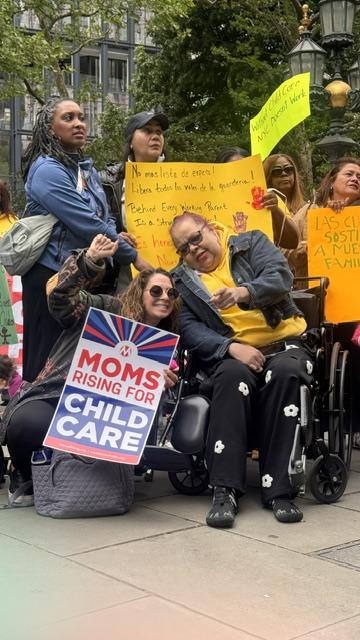
Early learning professional Gladys Jones shares her child care story as a family child care educator. After enduring a stroke, Gladys had to close her group family day care program GaGa Daycare and founded her grassroots organization ECE on the Move as well as continuing to fight for Early Childhood Education is recognized as essential.
Early learning professional Gladys Jones shares her story as a passionate family child care educator.
After enduring a stroke, Gladys had to close her group family day care program GaGa Daycare and built on her background in early childhood education to found her grassroots organization ECE on the Move.
Gladys has a vision in the future for universal child care where Early Childhood Education is recognized as essential.
Sharing My Story: Advocating for Child Care
For most of my adult life, I was known as a family child care educator.
Long before I became an advocate, organizer, or nonprofit leader, I was the owner and operator of GaGa Daycare, a group family day care program that I proudly operated from my home.
My days began before sunrise.
By the time families arrived at the door, I had already become whatever that day needed me to be. Every child who entered my program had unique strengths, and every family placed an incredible amount of trust in me. Those parents were working, struggling, hoping someone would show up for their kids the way they would if they could be there themselves. I was teaching long before anyone called it that.
It was never simply a business.
It was my calling.
Like every family child care educator I know, I ran a small universe out of my home and learned to navigate every corner of it.
I loved the work.
I never imagined it would become the foundation for something much bigger.
Over time, providers began calling me with questions.
Some needed help understanding regulations.
Others were struggling with delayed payments, licensing issues, or complicated systems that seemed impossible to navigate.
Parents began calling too.
The parents calling me weren't so different, mostly just needing someone to listen and point them somewhere useful. Families had always taught me that trust is everything in this work, and I tried to honor that in every conversation.
Looking back, I became an advocate the same way I became a provider: by showing up for people who needed someone to. What I kept hearing from everyone was the same story: providers who couldn't get straight answers, parents who couldn't find spots, and everyone navigating a broken system completely alone.
Those conversations kept growing until they became ECE on the Move: a community where educators, parents, advocates, and partners could find information, support, encouragement, and a collective voice.
Building ECE on the Move has been one of the greatest privileges of my life.
The Moment That Changed My Life
Then my own life changed in an instant.
Nearly two years ago, I suffered a stroke.
Nothing prepares you for a moment like that.
One day I was caring for children.
The next, I was learning how to care for myself.
Today, I live with partial paralysis on my right side. My speech is sometimes affected, and my right hand no longer functions the way it once did.
The physical recovery has been difficult.
The emotional recovery was even harder.
GaGa Daycare had to close, and that loss was not something I chose or was ready for. That program was where children took their first steps and parents exhaled for the first time all morning knowing their child was loved and safe. Losing it felt like grieving a person.
For a while, I wondered whether I still had something meaningful to contribute.
Recovery has a way of changing your perspective.
It forces you to slow down.
To observe.
To listen.
To notice things you once rushed past.
The Greater Vision For Child Care and Beyond
What I didn't expect was how much it would clarify. When a system isn't built for you, you feel it before you can name it, and I started recognizing that feeling from somewhere else entirely. It was the same thing I had watched family child care providers carry for years: that constant expenditure of energy just to exist inside systems that were never designed with them in mind. I had spent years seeing it from the outside and now I understood it from somewhere much closer, and that changed everything about how I advocate.
Those experiences reshaped my advocacy.
Today, I proudly identify as a disabled leader. Not because disability defines me, but because it has deepened my understanding of resilience, inclusion, and the importance of designing systems that work for everyone.
When I think about the future of Early Childhood Education, I think about the mother dropping her child off before sunrise the same way families once dropped their children with me, hoping the person on the other side of that door sees her child the way she does.
I think about the educator who closes a program because the financial pressures become impossible to overcome.
I think about the child who spends months on a waiting list during the most important years of brain development.
Today, more than 25,600 children in New York City remain on that waiting list.
Behind every number is a child whose learning has already begun, whether we choose to recognize it or not.
That realization has led me to a simple but profound belief.
We have spent decades treating child care primarily as a human services program.
While supporting families is an essential part of its purpose, it is not the whole story.
The women running these programs out of their homes are educators. They always have been.
That work deserves to be recognized and resourced as education. It has its own identity, its own professional standing, and it has earned sustained public investment, not as an extension of K-12 and not solely as a social service.
Changing that perspective changes everything.
It changes how we value educators.
It changes how we support families.
It changes how we invest in children.
My vision is universal child care from birth through age 13.
Children's need for safe, nurturing, educational environments does not end when they enter kindergarten, and families' need for support does not end when preschool ends.
Our policies should reflect the realities of children's lives and the realities of modern families.
When I look back I can see that nothing in my journey was wasted because the classroom taught me how children learn, families taught me that trust is the foundation of everything, and advocacy taught me that lasting change begins by really listening. My disability taught me that leadership isn't measured by what we've lost but by what we continue to give.
I did not choose the path that brought me here.
But I choose, every day, to keep moving forward.
I choose to believe that we can build a future where no child waits for the opportunity to learn, where every family can access the support they need, and where Early Childhood Education is finally recognized for what it has always been: the first and most important chapter of a child's education.
That is the future I will continue working toward.
When a system isn't built for you, you feel it before you can name it, and I started recognizing that feeling from somewhere else entirely….. [Child care] deserves to be recognized and resourced as education. It has its own identity, its own professional standing, and it has earned sustained public investment, not as an extension of K-12 and not solely as a social service…. My vision is universal child care from birth through age 13.
How You Can Help Address the Child Care Crisis
Tell us your story: New Yorkers, share your child care experience in order to show our leaders that high-quality, affordable child care is a priority for their constituents! You can share your child care story in Spanish as well!
Frequently Asked Questions
What profession does Gladys work in and have passion for?
Gladys is a family child care educator.
Why did Gladys want to found and build ECE on the Move?
Gladys founded the grassroots organization ECE on the Move after many years working as a child care educator. After enduring a stroke, she had to close down her group family day care program GaGa Daycare and understood the importance of Early Childhood Education to be recognized as its own educational modality with its own identity, standards, and expertise through ECE on the Move.
What is Gladys’ vision for the future of child care?
Gladys’ vision for the future of child care is universal child care. She wants to change the way society views Early Childhood Education into a system that supports families, values educators, and recognizes that learning begins at birth, and believes in changing child care policy to reflect that.
Early learning professional Gladys Jones shares her story as a family child care educator. After enduring a stroke, Gladys had to close her group family day care program GaGa Daycare and founded her grassroots organization ECE on the Move as well as continuing to fight for universal child care and for Early Childhood Education is recognized as essential.

The views and opinions expressed in this post are those of the author(s) and do not necessarily reflect those of MomsRising.org.
MomsRising.org strongly encourages our readers to post comments in response to blog posts. We value diversity of opinions and perspectives. Our goals for this space are to be educational, thought-provoking, and respectful. So we actively moderate comments and we reserve the right to edit or remove comments that undermine these goals. Thanks!