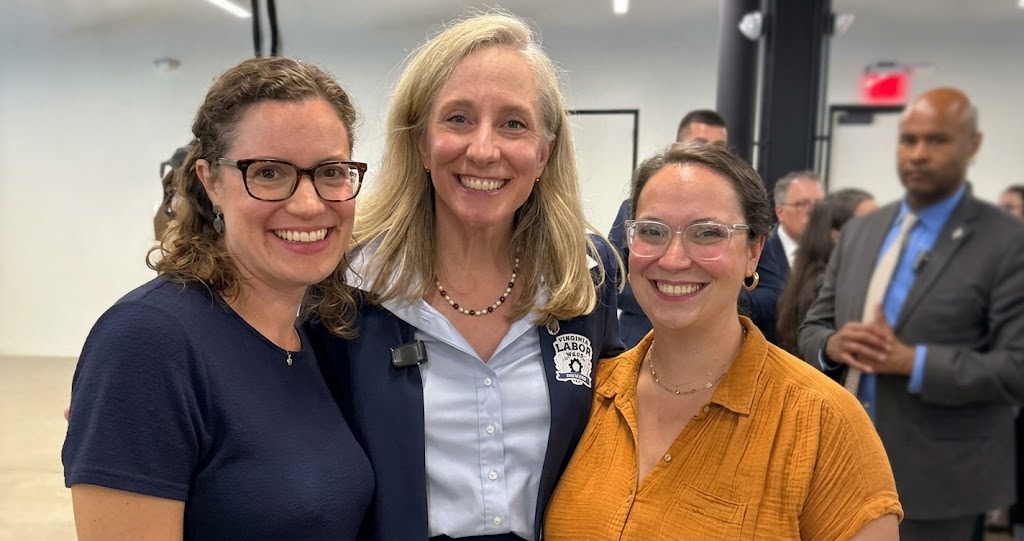
Sharing What Paid Leave Means for Virginia Families, MomsRising Members Meet with Gov. Spanberger

At a Glance
MomsRising members Molly Middlehurst and Anna Lukacs joined Gov. Abigail Spanberger for Virginia's Labor Week Working Families Roundtable. They shared valuable insight on how the state's new Paid Family and Medical Leave and paid sick leave laws can be implemented in the most helpful ways for families like theirs.
- Paid leave is a lifeline, not a perk: DC's public paid leave was Molly's only income after she lost her job mid-maternity-leave.
- Anna hoarded sick days for years in lieu of medical leave: Anna, an Alexandria teacher, had no guaranteed leave — just sick days she banked herself.
- Advocating for Equity: The couple urged the governor to make the new law work for queer families navigating adoption.
Last week, Virginia celebrated Labor Week, a time to recognize the contributions of workers to the Commonwealth's strength and prosperity. During the weeklong celebration, Gov. Spanberger convened a roundtable of advocates and workers to discuss Virginia’s historic new paid leave law — the first of its kind in the South. Her goal? To hear how the policy will affect real households and ensure it works for the people who will actually use it. Joining the governor were Virginia Secretary of Labor Jessica Looman, Delegate Briana Sewell, and Senator Jennifer Boysko.
MomsRising had the opportunity to attend the roundtable as well, with two of our members, Molly Middlehurst and Anna Lukacs, a married couple living in Virginia with their 1.5 year-old child, Leo. Molly and Anna shared the story of their family and how paid leave was a lifeline that kept their family afloat when Molly was laid off mid-maternity leave.
Here’s their story.
Access to Paid Leave Shouldn’t be Zip Code Dependent
They’re married, they had a baby, but because one of them worked in DC and the other worked in Virginia, Molly and Anna had two vastly different maternity leave experiences when baby Leo arrived.
Molly: DC-Based Nonprofit
Molly qualified for DC's paid leave program through her DC-based employer. She combined public paid leave, short-term disability, and saved PTO. She told the roundtable that DC’s paid leave law was a life line when DOGE cuts resulted in her losing her job.
Anna: Alexandria City Public Schools
Anna had zero weeks of guaranteed parental, medical, or family leave. She relied on years of accrued sick leave, which she used as maternity leave. She raised the need for leave timed to when a child arrives — including through adoption.
Molly’s Story: Paid Leave Was a Lifeline When the Rug Was Pulled Out From Under Her
Molly was excited to use DC’s paid leave law and grateful to have the time to care for her newborn son and heal from her c-section birth. Between that earned benefit for workers in DC, her employer disability coverage and banked time off, she planned to be home for six months.
Then the plan fell apart. In January 2025, federal funding cuts hit her organization hard:
"In January 2025, Elon Musk's Department of Government Efficiency began systematically and recklessly dismantling USAID along with the entire field I had dedicated my life to. My organization lost 80% of its funding...While on maternity leave with my newborn, I was furloughed with a 6-week-old and then laid off with zero severance."
Her short-term disability coverage disappeared along with her job. Her unused sick leave was gone overnight. The one thing that held: DC's public paid leave.
"DC's paid family leave policy was a lifeline for our family during that time. Without it, I wouldn't have had any income... It was a stark reminder of why we need public policy to guarantee paid leave for all workers, rather than depending on employer benefits."
That safety net carried her family through $2,000-a-month child care tuition until she found new work the following February.
Anna's Story: Leave Built for Every Family
Because Virginia hadn't yet passed paid family and medical leave, Anna had no paid family leave from her job as a teacher in Alexandria City Public Schools to use when Leo was born. Zero weeks of maternity leave. Zero weeks for a serious health issue or to care for a family member. Just her own accrued sick leave and whatever she'd managed to save up in advance.
"Because we always knew we wanted to have a family, I spent years accruing as much sick leave as possible to eventually use as maternity leave. That was stressful because it meant I felt pressure to come to work even when I was sick."
That pressure showed up in small, telling ways, including coming to school in a mask while sick with COVID during Molly's pregnancy, unwilling to spend a sick day she'd need later.
Anna spent years banking almost two months of sick leave before Leo was born, but it wasn’t enough, and she couldn’t even use all of it. She had to hold some back, knowing she’d need it for Leo’s checkups and the inevitable sick days that come with a new baby. What she had left ran out before Molly’s C-section recovery, so Anna went back to work while Molly was still healing and Leo was still an infant.
Then Molly lost her job, and the family needed Anna's income more than ever. Staying home longer, even unpaid, was not an option.
Anna wasn’t the only one at her job wrestling with the lack of paid leave. She shared that a colleague who hadn't yet accrued enough sick leave as a new teacher had to suffer the indignity of asking coworkers to donate leave to her so that she could stay home and recover from major surgery.
The roundtable gave Anna a chance to share how paid leave would have helped their family, and raised issues administrators need to hear as they implement the law: timing matters for queer families like hers. Families navigating confirmatory adoptions, like second parent adoptions, need access to leave as soon as a child arrives, not once officials finalize the paperwork.
These real-world examples of how parents use paid leave matter for administrators implementing new laws. And it’s exactly why Gov. Spanberger convened this roundtable: to hear directly from workers and gather this firsthand feedback to build a smoother, more inclusive implementation process.
"If I hadn't been able to take leave until [the paperwork was finalized] then I wouldn't have been with my family when they needed me most. So we need to ensure that the new policy allows queer parents to take leave when children are born, not only when the adoption paperwork is signed."
As they put it: access to paid leave shouldn't depend on your zip code, your employer, or your family structure.
The Work Isn’t Over: What Comes Next
Virginia's new paid family and medical leave law is a huge victory for families like Anna and Molly’s. As the first law of its kind in the South, it’s a model other states can follow.
Virginia still needs stories like Anna and Molly’s to help shape how officials implement the law, and to keep the MOMentum going until every family, in every state, has access to paid leave. MomsRising would love to hear your story about how access to paid family and medical leave, or lack of paid leave, impacted your family. Every family has a different perspective that can help administrators as they continue to as officials make implementation decisions.
What does paid family & medical leave mean to you?
Your perspective can help administrators create and implement paid leave policies that work for the families who actually use them.
Share Your StoryLearn More
Want to learn more about this historic new law?
Check out this great article from Ms. Magazine and this FAQ from the Virginia Employment Commission.
What is Virginia's new Paid Family and Medical Leave law?
It's a state-administered program guaranteeing paid family, medical, and sick leave to Virginia workers. It’s the first law of its kind passed in a Southern state.
Related Posts


The views and opinions expressed in this post are those of the author(s) and do not necessarily reflect those of MomsRising.org.
MomsRising.org strongly encourages our readers to post comments in response to blog posts. We value diversity of opinions and perspectives. Our goals for this space are to be educational, thought-provoking, and respectful. So we actively moderate comments and we reserve the right to edit or remove comments that undermine these goals. Thanks!