Sometimes, even a healthy food isn’t so healthy.
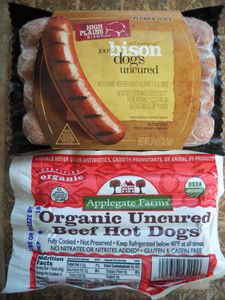
Take, for example, the package of bison hot dogs I received recently for review. Bison, I know, is an incredibly healthy meat, especially when compared to beef: it’s lower in calories, fat, and cholesterol. So surely hot dogs made from bison would be similarly impressive, right?*
Eh, not so much.
As a Lifetime Member of Weight Watchers, I read Nutrition Facts Statements habitually—I don’t remember the last time I ate something without checking to see what was in it. So of course, before I cooked a bison dog for my son, I read the label. What I saw, frankly, shocked the pants off me:
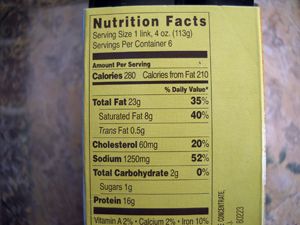
Bison Hot Dogs
100% all natural bison dogs/uncured
Serving size 1 link, 4 oz (113g)
280 calories
23g fat
8g sat fat
1250mg sodium
16g protein
These numbers are troublingly high. They're on par with Hebrew National, and more than double Applegate Farms beef hot dogs.
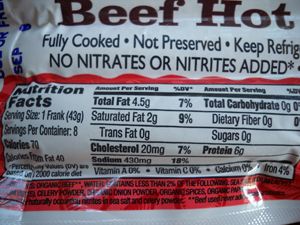
Applegate Farms Organic Uncured Beef Hot Dogs: By weight, two of these pups equals one bison dog, and bison's numbers are still twice as high.
How can something whose primary ingredient has 109 calories and less than 1 gram of saturated fat per 100 grams get all the way up to 280 calories and 8 grams of saturated fat in 113 grams? And 1250 mg of sodium? I believe that's an entire day's worth for my 4-year-old.
I wrote exactly that to my contact at the bison company who’d sent me the meat. Here is her response:
Hi Debbie,
I had a long conversation with the person who is responsible for producing the non-muscular products and he said that the numbers are accurate. Our goal was to make an all-bison dog, that did not include fillers including beef fillers that many of our competitors use to both lower the cost of production and help with binding the meat. Because we were committed also to not including artificial binding agents for a product as lean as bison, we use sodium to help us on the binding front.
I hope that helps, and if you have any more questions, please feel free to contact me.
Thanks,
[name redacted]
Now, I commend them for avoiding fillers and artificial binding agents, but it seems like they’ve substituted ingredients that are equally ill-advised—even though they’re all-natural. Such a great idea, but ultimately so unhealthy I won't serve it to my kid. While it may be all-bison, it sounds like it must be mostly bison fat, not meat.
I wrote that to my contact, too. She didn’t correct me.
Today’s lesson: Always read the Nutrition Facts Statement—don’t assume that when something is made from healthy ingredients, it’s automatically healthy. Because as Felix Unger Oscar Wilde said, “When you assume, you make an ass of u and me.”
* Before you point out that hot dogs are inherently unhealthy: I know. Even feeding my boy Applegate Farms is probably doing some kind of irreparable damage. But what can I say? We’re a hot dog family.
Related Posts


The views and opinions expressed in this post are those of the author(s) and do not necessarily reflect those of MomsRising.org.
MomsRising.org strongly encourages our readers to post comments in response to blog posts. We value diversity of opinions and perspectives. Our goals for this space are to be educational, thought-provoking, and respectful. So we actively moderate comments and we reserve the right to edit or remove comments that undermine these goals. Thanks!