Kristin Rowe-Finkbeiner

    Maternal Profiling: A New York Times Buzzword
    Posted December 30th, 2007 by Kristin Rowe-Finkbeiner

    Written by Mary Olivella, Joan Blades, and Kristin Rowe-Finkbeiner

    Every once in a while a word or phrase is introduced into the lexicon that sheds light on a widespread practice which hasn’t yet entered the national consciousness. These phrases take hold because we need them.

    A few days ago, the New York Times listed a sampling of 2007’s newly coined buzzwords – words “that endured long enough to find a place in the national conversation.” Maternal Profiling was one of these. The New York Times defined it as:

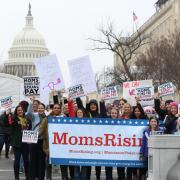
    “Employment discrimination against a woman who has, or will have, children. The term has been popularized by members of MomsRising, an advocacy group promoting the rights of mothers in the workplace.”

    Credit is due to Cooper Monroe from MomsRising.org who coined the phrase to describe the profound bias mothers face in the workplace. The phrase has struck a cord at a broader level for all mothers who feel pegged and discriminated against whether in the labor force or as stay-at-home moms.

    Maternal profiling is a term being used by the more than 140,000 (and growing) MomsRising.org activists who are bringing the concept into the public consciousness.

    Although seldom discussed until fairly recently, maternal profiling is a significant and shared problem which negatively impacts vast numbers of women, particularly since a full 82% of American women become mothers by the time they are 44 years old.

    The workplace impacts of maternal profiling are jaw dropping, especially given that three-quarters of American mothers are now in the workforce. In fact, the American Journal of Sociology recently reported a study which found that mothers are 79% less likely to be hired than non-mothers with equal resumes and job experiences.

    Mothers also face steep wage hits and unequal wages for equal work. One study found that women without children make 90 cents to a man’s dollar, but women with children make only 73 cents to a man’s dollar. And single mothers make about 60 cents to a man’s dollar.

    Even in well-paid positions, mothers face discrimination. A Cornell University study found that mothers were offered $11,000 less in starting pay than non-mothers with the same resumes and job experience, while fathers were offered $6,000 more in starting pay.

    That same study also found that mothers were held to harsher work standards than non-mothers and were taken off the management track for reasons that were not justifiable when compared to the behavior of other workers.

    The dirty little secret of the American workplace is that maternal profiling is alive and well and has been for a very long time. We just didn’t have words to label this form of discrimination.

    The repercussions of this discrimination are far reaching and they are intricately linked with issues of poverty, a deficit of women in leadership positions, and the future of our country’s children.

    A quarter of American families with children under six are living in poverty. Having a baby has been documented as a leading cause of “poverty spells” in our country — a time when income dips below what is needed for basic living expenses such as food and rent.

    Right now, the vast majority of workplaces are still structured from the era when it was assumed that there was a wife at home full-time with the children–even though this has never been the case for many low-income families. The majority of women, of mothers, are in the workplace to stay now—and it increasingly takes two incomes to support a family.

    The good news is that we know how to narrow these wage gaps and how to stop maternal profiling. Countries with family-friendly policies (such as paid family leave after the birth of a child and subsidized childcare) don’t have the same degree of maternal wage hits as we do here.

    But we have work to do. It’s time to catch up. The United States lags far behind other countries when it comes to supporting families. For instance, Harvard researchers studied over 170 countries and found that the United States was one of only four nations without some form of national paid leave for new mothers. (The others were Liberia, Papua New Guinea and Swaziland.)

    Unfortunately, so far only one state in our nation, California, provides for paid parental leave though Washington State will follow soon. The lack of paid family leave often causes parents to either quit much-needed jobs to care for their newborn (and thus lose their job-linked healthcare coverage), or else the financial hardship of living without paid leave drives women back to work earlier than they would have chosen. Yet when parents return to work, they face a chaotic and costly childcare system where the cost of care for two children can easily be upwards of $20,000 per year.

    Then there’s the ever present question of what to do if you, or your child, gets sick. The absence of policies supporting a minimum number of paid sick days can force parents to choose between leaving a sick child at home alone, or staying home to care for their child and consequently losing income or possibly being fired. And, here too we lag behind other nations. Looking at the twenty countries with the top economies in the world, the United States is the only one that does not have a national minimum standard for paid sick days.

    Given that we lag behind on family-friendly programs, it is not surprising that we also lag behind on the health of our children. Although we spend more per capita than any other country on healthcare, the United States is ranked a low 37th out of all the nations in respect to childhood mortality. International studies have shown that paid family leave policies decrease infant mortality by an impressive 25%.

    All of the above is compounded by the fact that one in eight American children doesn’t have any health care coverage at all. (This is yet another area where we lag behind: The United States is the only industrialized nation which doesn’t have some form of universal health coverage).

    It’s easy to see how having a baby in a nation without support for families could cause a downward financial spiral that lasts a lifetime—and how a lifetime of maternal discrimination can create a vicious cycle for the next generation.

    We can solve these problems. We can end maternal profiling. American mothers and families are struggling, not because of an epidemic of personal failings, but because we need changes in our national policies, our workplaces, and our culture to reflect that women are in the workplace to stay and that the majority of them have children.

    Women across the socioeconomic spectrum, and across the diverse backgrounds of all American families, are negatively impacted by maternal profiling. They (and many men) are becoming progressively more vocal about the need for our country to create family-friendly policies.

    Another related phrase, “family responsibilities discrimination,” has been popularized by legal scholars such as Joan Williams to describe discrimination against employees who have care giving responsibilities. The Center for WorkLife Law has seen a 400% increase is such cases filed during 1996-2005 over the previous decade.

    MomsRising.org was launched in 2006 to offer mothers and others an opportunity to collect and amplify our voices in order to bring about a cultural shift and policy changes in how our country treats mothers.

    We can take the next step towards gender equity by ending maternal discrimination and by building a family-friendly America where having children does not create economic disparities for women. Just as the term sexual harassment transformed American workplaces, maternal profiling can contribute to creating workplaces that do not discriminate against mothers and other caregivers.

    Maternal profiling – it’s as bad as it sounds. Let’s get rid of it.

    Posted Under: Uncategorized
    Permalink

    147 Comments

    January 5, 2008 at 12:15 pm by Randi Anderson

    Thank-you for validating what I have been feeling!

    I have been beating myself up for months now. I recently completed my Masters, started and developed a successful nonprofit over the last 2 years, and had an amazing internship (all while being the sole parent of an active toddler). I am now attempting to get hired for a ‘livable’ position. I have sent out resumes for positions in which I fully qualify, but am not even getting interviews. I have been rejected for positions without as much as a phone call- letters to add to my rejection letter pile. THEN, I have seen the positions re-advertized! (This has happened more than once.)

    I’m going to revamp my resume- removing “Single 2 Mother”, the one thing that I am most proud (other than my son). I do believe that having “Single Mother” written across my resume has worked against me. During a time that I should be feeling proud, I am feeling destroyed, angry, and depressed….

    I can not help but feel that this “Maternal Profiling” is ABSOLUTELY true.

    Thank-you!
    Randi Anderson
    Single 2 Mother
    http://www.single2mother.org

    [Reply]

    January 5, 2008 at 11:52 am by Anonymous

    I was one of the women who, in the heady optimism of the Women’s Movement, believed I could have it all. I had completed a PhD in biology, was married, had an 18-month old son, and was headed off to the post-doctoral research position of my dreams at a major university on the West Coast. Unfortunately, “having it all” was not to be the case. During my second year of research at that university, I became pregnant with my second child, and informed my research mentor that I would be switching from experiments involving exposure to high levels of radioactive isotopes, to other , safer experiments not involving radioactivity. I would have thought that my research mentor, a biologist well versed in the risks of exposure to radioactivity during pregnancy, would have accepted this decision without question. HE proceed to let me know that I was clearly “not a serious scientist”, and in addition, when I sought to continue with additional years of research in the same lab, it was made clear that there was no room for me in his lab because I had not demonstrated total commitment to science My crimes: a) I was a mother of TWO children, and b) I refused to work with highly radioactive isotopes during pregnancy.

    [Reply]

    January 5, 2008 at 11:47 am by Anonymous

    Last year I had two job interviews, and made the mistake of announcing my pregnancy before the interviews. The first place gave a lot of lip service to being a family-friendly environment, but during the interview I was told that my interviewing while pregnant was “very bold”, and I was later told that, although they thought I was a great candidates, they wanted someone who would have an “easier transition” than I would have. The second place did not seem to mind my pregnancy, but did mind the fact that I was married. I was their first choice for the position, but they were not sure if my husband would be able to find a job in the area, so they offered the job to someone else who was already settled in the area.

    [Reply]

    January 5, 2008 at 11:43 am by Anonymous

    Those “best companies” for working moms ratings are baloney. I have found that this rating usually applies to women who are already in management positions; however, the receptionists, administrative assistants or accounts payable clerks don’t get the same type of benefits. I, too, have worked for these so-called “mom-friendly” companies and I have yet to see the benefits available for execs offered to regular staff. I think it’s completely disgusting that such disparity exists. Working moms–at all levels–should receive the same benefits!

    For anyone reading this, please also beware of receptionists, office managers, admins, etc. who try to chat you up before your interview. I had an experience with an office manager who came out to apologize that my interviewer was running late. Then she started making small talk about commuting to the office, and how it can be so difficult to juggle getting kids to school, etc. and then said “well, you know how it is…”, attempting to open up a conversation about my own situation. I could tell what she was up to so I simply replied, “Gosh, I can imagine how hard that must be for you.” I guess she got the message because she changed the subject. I was hired, but found out later this was part of their strategy: since people are primed for “interview questions,” they would have the receptionist or office manager engage the candidate in seemingly innocent chit-chat (which, of course, gets reported back to the interviewer). Stay on your toes, ladies!

    [Reply]

    January 5, 2008 at 1:20 pm by Anonymous

    Maternal profiling is sexism. What we feminists have been trying to get your Mother’s next generation to acknowlede. It’s too late for you. What you do now may make a difference for your children. Demanding does noting. Politicians are elected. BY YOU. You have to run against them and get elected yourself. Otherwise all we will continue to get is rhetoric. You have to be in a position to make change by having a vote in legislatures. That is where the real power is. The real power of the vote.

    No one in this country has a right to work. This is not sexism.

    [Reply]

    January 5, 2008 at 1:20 pm by Anonymous

    When I graduated with my Masters in Social Work, I was a little over three months pregnant with my first child. I was interviewing with various social work agencies without disclosing my pregnancy, as I was not showing. I felt uncomfortable about this, as I wanted to be honest with prospective employers, but also wanted to receive a fair chance at the job. One of the agencies offered me a full-time position working with homeless, mentally ill adults. Before accepting the offer, however, I disclosed my pregnancy–I wanted to be honest with my new employer. The next day, the HR department (who I had never spoken with before) called to rescind my employment offer. I never reported the agency, simply because I didn’t want those they served to experience the ramifications of my action, if there were any.

    Later, I interviewed with another, highly respected agency for a part-time position. After two very involved, lengthy interviews I was told that I was being considered for the position along with one other candidate. They kept pressing me as to why I wanted a part-time position, saying they wanted to make sure I wasn’t going to leave them for a full-time job at a later date. I then disclosed my pregnancy, citing that having a child was my reason for wanting to work part-time, so they didn’t have to worry about me going anywhere. I never heard from them again.

    After both of my experiences, I became very disheartened. Of all professions, social work definitely should be one that is family friendly, but that is not what I experienced. I took a temporary job that I could do from home which was unrelated to my field and which did not make me happy. My child is now one year old and I have not worked professionally since he was born.

    [Reply]

    January 5, 2008 at 1:19 pm by Anonymous

    I am a childless married woman in my late 30s who works as a scientist in the biotech industry in Seattle. In the past year I was looking for a job. I sent my resume to a small startup biotech, and got an e-mail from the company founder, a young businessman. He said that he didn’t have a position open at the moment, but wanted to have a discussion over coffee to talk about science. At his office, we discussed science for a while, and I eventually noticed that he was distracted by something on his computer monitor. He then said “Oh, I’m sorry, I get so distracted when I see this picture,” and he turned around his monitor to show me a photo of two young children, which he told me were his. I remarked that they were cute. He then proceeded to ask “Do you have children?” I told him I didn’t. The very next question was “Do you plan to have children?” I laughed and said “Who knows!” Of course, these weren’t illegal interview questions, because this was not an interview, as he had been careful to specify before we met! When I left, he told me he would be in touch, but I never heard from him again. Irritated by this experience, I did some searching on the web and found many similar stories from women looking for jobs. The idea behind showing a female candidate a photo of children is to get them gushing about children and to mention that they have their own. Another thing that the guy did, mention that he was big on work-life balance, is sometimes used to elicit enthusiasm about that concept, and, again, get a female candidate to confess that she has children. One blog even mentioned to not let an interviewer walk you to your car, because the interviewer might check it for evidence of children (car seats, toys, etc.). This type of discrimination, maternal profiling, is alive and well!

    [Reply]

    January 5, 2008 at 1:02 pm by Anonymous

    I formerly worked for a large corporation that is often lauded for its mother, father, and family friendly policies. When I was 5 months pregnant with my only child I was placed on bed rest. My cervix was opening prematurely. My OBGYN filled out all of the paper work that my company requested. Despite this my direct manager (a man) called the clinic and spoke to my OB and a nurse working at the clinic about my pregnancy. This was my first position with a company out of college. It was my doctor who informed me that my manager’s behavior was inappropriate and that I should contact my company’s HR department. I ignored my doctor’s advice. This manger was promoted within 6 months of this incident.

    When my son was 5 months old he was admitted to Children’s Hospital in Minneapolis with spinal meningitis. My husband and I were terrified for days as we waited for the doctors to tell us whether our son would survive, and if so, suffer brain damage. Luckily, our son had viral, not bacterial, meningitis. He was hospitalized for over a week, but suffered no permanent damage. When I returned to work after this ordeal my new manager (a woman) requested a meeting with me. She told me during our meeting that it’s impossible to be a good mother and a good employee. She went on to explain that women must decide to be mediocre at both or good at one or the other. She asked me if it was possible for my husband to support us as a family given my son’s recent health issues. She said all of this in a manner of friendliness and confidentiality. It was not possible for my family to survive on one income, so I continued to work for this company. When my son was nearly two I was passed up on a promotion to manager. A younger, single man that I had trained in on our team received the promotion. I had always received positive customer feedback and peer reviews. Many of my colleagues, including a member of the committee involved in deciding who would be manager, expressed surprise that I was passed over for the promotion. I later decided to leave this company to return to school and pursue a career in an entirely new field. I never reported either manager to the HR department.

    Not reporting these incidences to HR was a failing on my part. I failed myself and the other women working for this company. Every mother has a right to work. Every mother has the right to try to be a good mother and a good employee. During this election year I have heard many politicians discuss the importance of healthy families in this country. We need to demand that the politicians and corporations back their rhetoric with policies that truly support working mothers, fathers, and their families!

    [Reply]

    January 5, 2008 at 12:48 pm by Anonymous

    I am a physician, and was interviewing this year for a contract job with specific, somwhat unusual, qualifications, all of which I fit very well. The job required some travel. During the hiring process, the recruiter told me that the agency had concerns because I have a small child, and they worried that unpredictable travel might cause problems for my family in terms of childcare arrangements, etc. He revealed that the had a less qualified single male candidate they were considering for this reason, despite the fact that this candidate had already expressed that he was uncomfortable with some of the job requirements because of his inexperience in those areas. I told the recruiter I was offended and angered that these issues were coming up, and that I suspected his questions about my family situation were illegal. (I have since learned that apparently they were not!) I told him I was fully aware of the job description and logistical issues that might come up, and had of course taken our childcare needs into account. In the end they hired me anyway, but it certainly left me with a bad taste.

    [Reply]

    February 14, 2008 at 3:34 pm by JaneV

    Reading through these comments and other recent articles in my newspaper makes me realize that our entire “American” society needs an attitude adjustment. With so many families needing both parents to work in order to afford even a modest home (on top of expenses like health insurance, student loans, etc.) companies need to accept that their employees have lives and families outside the office and not punish (or refuse to hire) them if they want to be home by 6:00 p.m. in order to have a family dinner and use their weekends to spend time with their kids. Why does our government support a society where strangers (if anyone) is raising the kids because the parents have to work long hours in order to provide basic needs? I’m tired of trying to justify my desire to “only” work 40-45 hours a week to prospective employers because I’d like to see my kids more than just one day a week. At the same time, I want to get paid a decent wage in order to help pay for basic needs because my husband isn’t making six figures.

    I have no regrets in my decision to have kids, or my choice of husband (despite his modest income). I do regret my career choice and wish someone had told me in college that my career interest meant that I’d have to choose between a family and being employed. Of course, I have no idea how we would even have afforded our modest home but for my income before I had kids.

    [Reply]

    Leave a Comment

    Your name is required
    An Email address is required

    Notify me of follow-up comments via e-mail

    x
    READ OTHER MOMSRISING STORIES